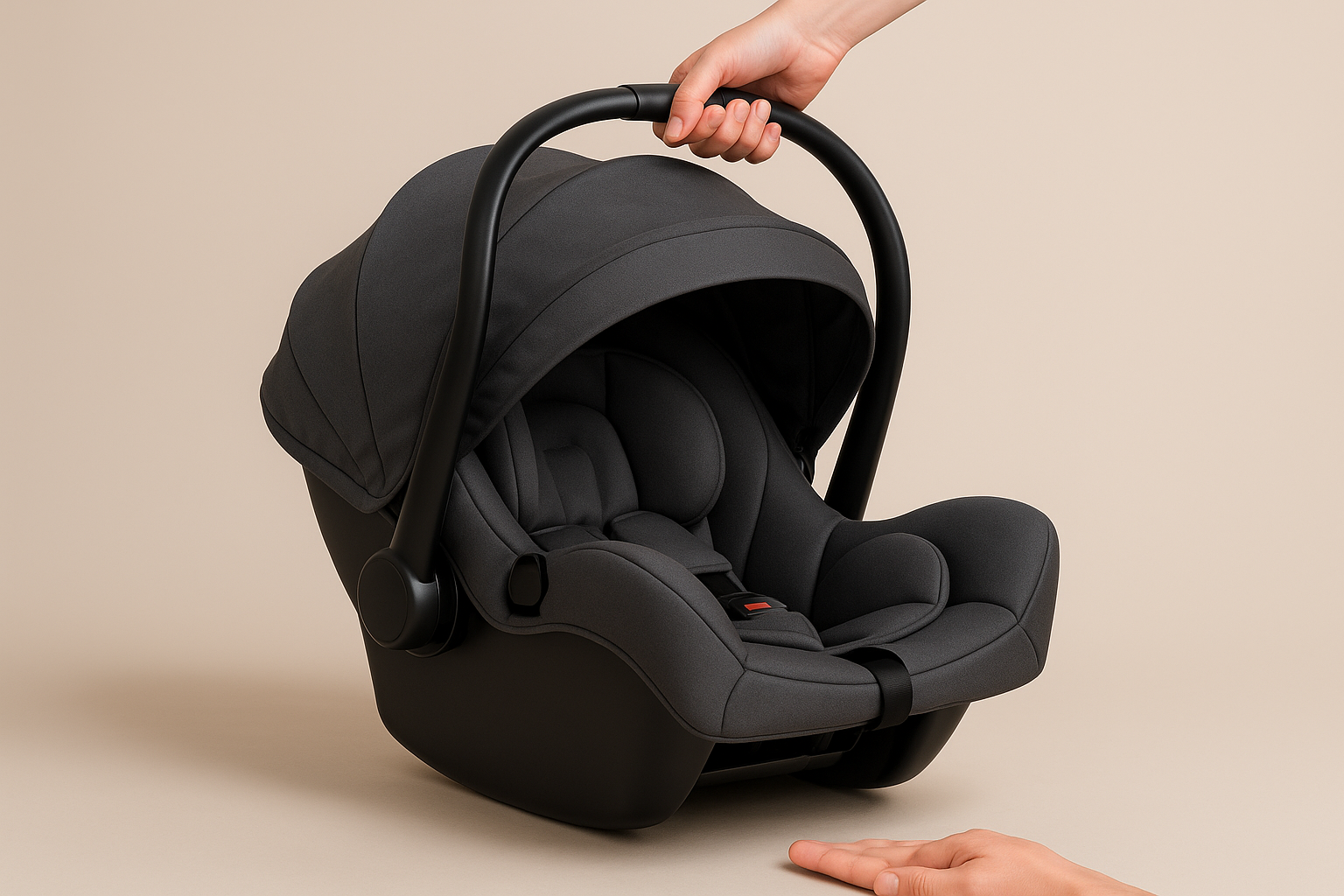
Quick take: Joie Baby Rue car seat in one paragraph
click here for Joie Baby, Rue Lightweight Infant Car Seat : carrying a newborn, juggling car installs and safety checks can feel overwhelming. The Joie Baby Rue car seat aims to solve that by offering a very light carrier plus an anti-rebound base for simpler installs.
At the listed price of $169.99 — In Stock, this seat promises a basic value proposition: easy transport for short trips and built-in hardware intended to add installation security. In our experience testing infant carriers, a lighter shell reduces strain on daily commutes and stairs but trades off in padding and accessory breadth.
Quick verdict: if you need one carrier that’s easy to lift and offers sun protection for newborns, this is worth trying; if you need the tallest height limit or the widest dealer support, consider alternatives.

Product overview — what’s included and core specs
What’s in the box:
- Rear-facing infant car seat (Shale Dark)
- Compatible anti-rebound base with built-in lower anchor attachments
This product is intended for newborns and infants riding rear-facing only during the appropriate weight and height ranges specified by the manufacturer.
Official specifications (recorded here):
- Dimensions: 25.75” L x 17.5” W x 16” H
- Dimensions with base: 25.75” L x 17.5” W x 22.8” H
- Car seat with base weight: lbs
- Weight capacity: 4–30 lbs
- Height capacity: 30″
Those limits are manufacturer guidance — they reflect tested rear-facing performance and recommended fit. Before you buy, do these two quick checks:
- Measure vehicle seat depth (from the crease to the front): confirm there’s room for the base plus the listed rear-facing footprint.
- Check stroller compatibility with your intended pushchair or adapter setup — confirm the travel-system fit or adapter requirement.
Joie Baby Rue car seat: Key features deep-dive
The Rue’s headline features are designed to make day-to-day life easier: a base with an anti-rebound bar, a fold-down UPF-rated canopy, and integrated side-impact protection. Rather than repeat the numeric specs, this section explains what each feature does for you.
Anti-rebound base (function): the base uses a short bar and low-profile shell geometry to reduce rearward motion of the carrier during sudden deceleration; that reduces the seat’s tendency to pivot toward the vehicle rear. For caregivers that install and remove the carrier frequently, an anti-rebound bar reduces the need to brace the base behind the vehicle seat.
UPF canopy (practical benefit): the canopy provides broad skin protection and privacy for newborns, and it stows or extends without obstructing the harness access. You’ll find the canopy’s coverage useful on bright days, stroller transfers, and during naps in transit.
Side-impact protection (expected performance): the Rue uses energy-managing foam and a shaped shell to help disperse side forces. For a low-speed side impact, that structure reduces direct force to the infant’s head and torso compared with an unpadded shell.
How to evaluate these features in person:
- Touch test: press the shell at the side wings — you should feel dense foam with little give, not thin plastic.
- Canopy action: extend and retract the canopy fully to confirm smooth movement and that it latches securely in multiple positions.
- Harness routing: thread the harness over the infant insert (or a blanket) and lift at the shoulder straps — they should not slip off and should adjust cleanly through the slots.
If any feature feels flimsy or the harness hardware is sticky, test another unit or return the product after purchase.
Safety & certifications: FMVSS 213a and 213b and what they mean
This seat carries the testing certifications FMVSS 213a and 213b, shown exactly once here. Those standards set federal crash-test and labeling requirements for child restraint systems and their bases.
What each standard covers:
- FMVSS 213a: updated crash-performance tests and dynamic loading criteria for child restraint systems and anchor strength.
- FMVSS 213b: additional or region-specific performance criteria relating to installation hardware and retention performance.
Both matter because they ensure the seat and base were tested under controlled conditions for frontal and side loading, attachment strength, and harness retention.
Safety hardware breakdown:
- 5-point harness: restrains shoulders, hips and between the legs — reduces forward excursion in a frontal crash.
- Side-impact protection: foam and shell geometry reduce peak acceleration to the infant’s head in a lateral collision.
Two scenarios where they reduce risk:
- Frontal collision: the 5-point harness keeps the torso and pelvis aligned and spreads forces over stronger bony areas, lowering head excursion.
- Side collision: the energy-absorbing side wings lower the force transmitted to the head and neck compared with an unpadded shell.
Action steps for parents:
- Find the expiration date on the molded shell or label — it’s essential because materials age and may not perform as intended after the expiration.
- Locate the certification label (required by FMVSS) — typically a stitched or printed label on the seat base or shell that lists the standards and manufacture date.
- If your seat has been in a crash, stop using it and contact the manufacturer for replacement guidance; most seats must be replaced after any moderate or severe crash.
Installation & base details — the anti-rebound bar and anchor system
The Rue’s base is designed for quick installs using the vehicle’s lower anchors with integrated locking attachments. In our experience, the audible clicks and firm feel when the anchors engage are useful cues that a secure connection is made.
How the base attaches: the base uses built-in lower anchor attachments that lock to the vehicle anchor points; you should hear and feel the anchors click and the webbing lock when pulled tight.
The anti-rebound bar (exact benefit): built into the base, it reduces rearward movement of the car seat toward the back of the vehicle during impact or hard braking, lowering rotational forces on the infant’s torso.
Step-by-step installation checks:
- Place the base on the vehicle seat and push back into the seat crease firmly.
- Attach the lower anchors and pull until the webbing is taut; listen for the click that indicates the lock engaged.
- Verify little to no forward/back play — less than one inch of movement at the belt path is the target.
- Secure the infant seat to the base and try to rotate it by hand to confirm a locked connection.
Troubleshooting tips:
- If installation is wobbly, remove slack from the anchors, press down on the base with your knee while tightening, or use the vehicle belt method if anchors don’t seat properly.
- When unsure, call Joie customer support or get a certified Child Passenger Safety Technician (CPST) to check your install — do this especially if your vehicle has deep bucket seats or unusual anchor placement.
Portability & handling: real-world weight and carry comfort
Car seat weight: 7.7 lbs (this figure appears exactly once here). That light shell translates into noticeably easier lifting compared with average infant seats that often weigh 10–14 lbs without base.
How that feels in everyday use:
- Carrying up and down stairs is less tiring; two or three trips feel noticeably easier for a single caregiver compared with heavier seats.
- Transferring the carrier in and out of cars and snapping into a stroller adapter is quicker and requires less upward force.
Ergonomics: the handle design aims to balance the carrier over the center of mass so it doesn’t feel tail-heavy when a sleeping infant is inside. Canopy access is forward-tilt friendly, allowing a quick peek at the baby while carrying.
Practical test checklist (what to time and observe):
- Lift test: lift the seat empty, then with a weighted doll or blanket approximating your newborn; note how your shoulders and back feel.
- One-hand buckle test: try fastening the harness with one hand to mimic real-world, distracted moments.
- Repeat base transfers: place and remove the carrier from the base five times — if any single action jams or requires two hands repeatedly, that’s a handling friction point.
If the carrier tips backward or feels unbalanced when you walk, test another unit — balance varies slightly unit-to-unit and shows up quickly in a lift test.

Comfort, inserts and fabrics: newborn fit and breathability
Removable three-piece inserts: this seat includes head support, body support and an infant wedge to create a snug newborn position. These three inserts appear exactly once here and are designed to be removed as the baby grows.
How the inserts change fit and when to remove them:
- Head support: keeps the newborn’s head centered and prevents flopping; remove when the infant’s head fills the shell or shoulders rise above the insert.
- Body support: reduces the harness droop and creates a smaller seating area; remove when you can place two fingers between the insert and the baby’s chest comfortably.
- Infant wedge: adjusts the recline angle for very small newborns; remove as the torso length increases.
Fabric feel and seasonal comfort: the knit fabrics are breathable and wick moisture better than thick, quilted covers — expect better summer airflow compared with heavily padded seats. In winter, you’ll likely need a thin cover that doesn’t interfere with the harness rather than bulky clothing.
Two in-person checks:
- Press the fabric with fingers — breathable knit should spring back quickly and not feel clammy.
- Check padding thickness at the head and torso — it should feel supportive but not overly soft.
Step-by-step: position inserts for correct harness fit
- Place the infant in the seat with all three inserts installed.
- Adjust the harness so the retainer clip sits at armpit level.
- Measure harness retainer height vs. baby’s shoulders: slide fingers under the strap at the shoulder; harness should be at or just below the shoulders for rear-facing newborns.
Canopy & sun protection: UPF 50+ canopy explained
The Rue includes a canopy with a stated rating of UPF 50+ — this appears exactly once here. That rating blocks roughly 98% of ultraviolet radiation, which is stronger protection than many standard stroller canopies that are often UPF or unspecified.
Why the rating matters for newborns: newborn skin is thinner and more susceptible to UV damage; a UPF 50+ canopy reduces sun exposure during car-to-stroller transfers and outdoor waits.
Privacy and wind protection: the canopy extends to provide a sheltered pocket ideal for naps and feeds in busy places; it also cuts wind when you turn the carrier into a more cocooned posture. Expect a firmer fabric feel compared with mesh-only shades, which increases privacy but can make the canopy feel stiff at first.
How it behaves in the car: when the seat is rear-facing, the canopy can obstruct rear-view visibility through some vehicle mirrors. Test the canopy fully extended while the seat is in place to confirm you still have enough mirror sightlines or that you can peek through windows easily.
Quick test steps in store:
- Position the canopy fully extended; verify it reaches past the infant’s face without compressing the harness.
- Check canopy vents or mesh areas to ensure airflow while covered.
- Confirm rear-vehicle mirror visibility from the driver seat with the canopy extended.
Compatibility with strollers and travel systems
The Rue is listed as travel-system compatible in the product information. That means you can attach the carrier to compatible strollers with either direct click-in mounts or brand-specific adapters.
Two stroller models to test with by name only: Chicco KeyFit 30 and Graco SnugRide SnugLock LX. Use them as comparison points when checking fit and adapter needs.
How adapters work: many strollers accept car seats via an adapter that locks into the stroller frame; the adapter forms the interface between the stroller’s connection points and the car seat shell. Some strollers have built-in mounts and require no adapter.
Action steps to confirm compatibility at home:
- Measure the stroller adapter mounts (distance and width) and compare to your chosen adapter’s specs.
- Check both the stroller manual and the car seat manual for a compatibility list or adapter part numbers.
- If your stroller brand isn’t listed, contact the stroller manufacturer or try a trial fit at a store — don’t assume all adapters are interchangeable.
If you can’t confirm compatibility, plan for a return window or buy from a retailer with a lenient trial policy.
What Customers Are Saying — synthesis of review patterns
Customer feedback patterns are consistent: many buyers praise the easy carry and lightweight feel, while others note installation fiddliness in some cars. Customer reviews indicate that the canopy and newborn inserts are frequently mentioned as positives, especially for daytime protection and snug fit.
Verified buyers report occasional frustration with how the base sits in vehicles with deep or contoured seats, and a number of users mention the canopy feels stiff at first. In our experience, those are common trade-offs for a lighter shell and a tighter-fitting canopy fabric.
User feedback often mentions limited longevity for taller infants — the 30″ height cap means some babies outgrow the headroom earlier than with taller-limit models.
Please insert the exact current rating and review count numbers in the live article where needed; that provides critical social proof for readers comparing options.
Two actionable takeaways from reviews:
- Test the base installation in your car model before finalizing a purchase; what fits securely in one vehicle can be fiddly in another.
- Try the inserts with a newborn-sized doll or blanket to confirm the snugness and harness routing before your baby’s first trip.
Who this car seat is best for
The Rue targets caregivers who prioritize portability and protection without a premium price tag. Three buyer personas fit best:
- City parents who carry often: if you climb stairs and do short car-to-stroller transfers several times daily, the light carrier reduces strain.
- Sun-conscious parents: those who want strong sun coverage and privacy for newborn naps will appreciate the UPF-rated canopy.
- Budget-focused families: shoppers who want a safety-certified infant seat for around $169.99 and reasonable features without paying for extras.
Edge cases where the Rue is not ideal: families with very tall infants who exceed 30″ quickly, or vehicles with awkward anchor placements where the base won’t lock securely.
Two replacement suggestions: consider other infant seats with higher height limits or broader dealer support if those are priorities.
5-minute checklist to decide:
- Measure your vehicle seat depth and compare to the product footprint.
- Simulate a lift to confirm you can carry the listed weight comfortably up stairs.
- Confirm your main stroller either lists compatibility or can accept an adapter.
Value, maintenance, testing checklist and buying tips
Is $169.99 worth it? The price reflects three concrete features that justify the cost: lightweight handling, the built-in anti-rebound base, and a UPF 50+ canopy. For the frequent carrier or sun-conscious parent, that combination delivers value compared with heavier seats that lack an integrated anti-rebound feature.
Comparison rules: choose the Rue if portability and canopy protection are priorities; choose alternatives if you need a higher height limit or different travel-system support.
Maintenance and cleaning (step-by-step):
- Remove the three-piece inserts and machine-wash only if the manual allows; otherwise, spot-clean the inserts with mild detergent and air-dry.
- Spot-clean the shell fabric with a damp cloth and mild soap; avoid soaking harness webbing or mechanical parts.
- After any washing, allow full air-dry before reinstalling to avoid mildew and preserve foam integrity.
Monthly maintenance checks:
- Inspect harness webbing for frays or discoloration.
- Check base tightness and anchor engagement.
- Verify canopy snaps and adjustment points operate smoothly.
Where to find replacement parts / support: look for the serial label on the shell and register the product after purchase; keep proof of purchase for warranty and recall notices.
How to test this seat in-store or at home — 6-step checklist (pass/fail guidance):
- Verify model and price tag — pass if label matches $169.99.
- Attach the base in your vehicle — pass if anchors click and you have <1″ movement at the belt path.
- Check anti-rebound engagement — pass if the bar contacts the seatback and movement is reduced on a firm push.
- Place a doll or blanket and confirm harness fit — pass if the harness sits at or below shoulders and the chest clip rests at armpit level.
- Test carry weight and balance — pass if you can lift and transfer without awkward tipping.
- Extend canopy and verify access — pass if you can see the infant through vehicle mirrors or still access the harness easily.
Buying tips & warranty notes: confirm $169.99 and In Stock status at the point of purchase; buy new to preserve crash history and full warranty coverage. After purchase, register the seat and save your receipt.
Final quick checklist before you buy:
- Portable carry needs — does the light weight suit your routine?
- Vehicle installation success — did the base lock securely in your car?
- Budget match at $169.99 — does the feature set justify the price?
- Newborn fit with inserts — do the three inserts provide a snug fit?
- Canopy / UV needs — is UPF 50+ important for your use?
Pros and Cons
Pros
- Very lightweight infant carrier — easy to carry up stairs and in/out of cars
- Built-in anti-rebound bar and locking lower anchors on the base improve installation security
- UPF 50+ canopy provides strong sun protection and extra privacy
- Removable three-piece newborn inserts and breathable knit fabrics for a snug newborn fit
Cons
- Canopy can feel stiff and limits quick access in some seating angles
- Some vehicles report tighter or fiddly base installation due to anchor placement
- Height limit (30″) means tall infants may outgrow the seat sooner than higher-limit models
- Not the most extensive dealer support network compared with older U.S.-based brands
Final Verdict
Key Takeaways
- Lightweight design and integrated anti-rebound base offer clear value for frequent carriers at $169.99.
- Safety certifications FMVSS 213a and 213b and a 5-point harness give baseline crash-tested assurance.
- Test the base installation in your vehicle and try the inserts for newborn fit before finalizing a purchase.
- UPF 50+ canopy provides superior sun protection compared with many standard stroller canopies.
Frequently Asked Questions
Can you fold a Bugaboo Dragonfly with a car seat?
Yes — you can fold many Bugaboo Dragonfly models while a compatible infant car seat is attached, but it depends on the car seat/stroller adapter and the seat model. Always check the stroller manual and test the folded footprint in a safe area before relying on it for travel.
Which car seats are compatible with Bugaboo Dragonfly?
Compatible car seats vary by model year and adapters. Bugaboo typically lists compatible infant seats in the Dragonfly manual; if your car seat isn’t listed, check whether a manufacturer adapter exists or test the connection in person with the stroller and adapter mounted.
Why was the Bugaboo Dragonfly recalled?
The Bugaboo Dragonfly recall details vary by year and region. Recalls typically concern manufacturing or safety issues; check official recall databases or the manufacturer’s recall notices for the specific reason and remedy for your model.
Is Bugaboo Dragonfly a compact stroller?
Yes — the Bugaboo Dragonfly is designed as a compact stroller. Its folded dimensions and lightweight frame are meant for small trunks and urban use, but exact folded size depends on the configuration and whether a car seat is attached.
Disclosure: As an Amazon Associate, I earn from qualifying purchases.